
RECENT REVIEWS
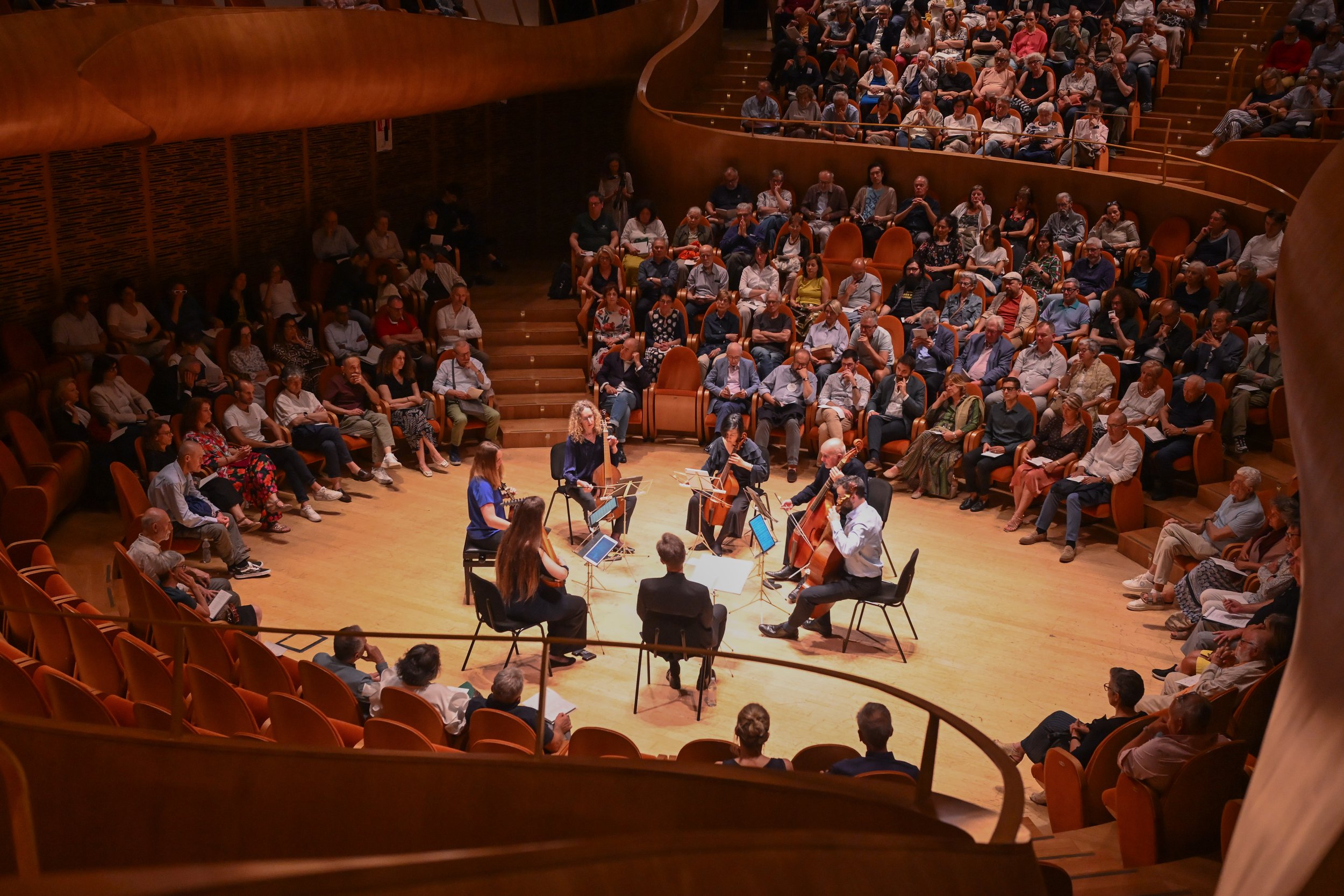
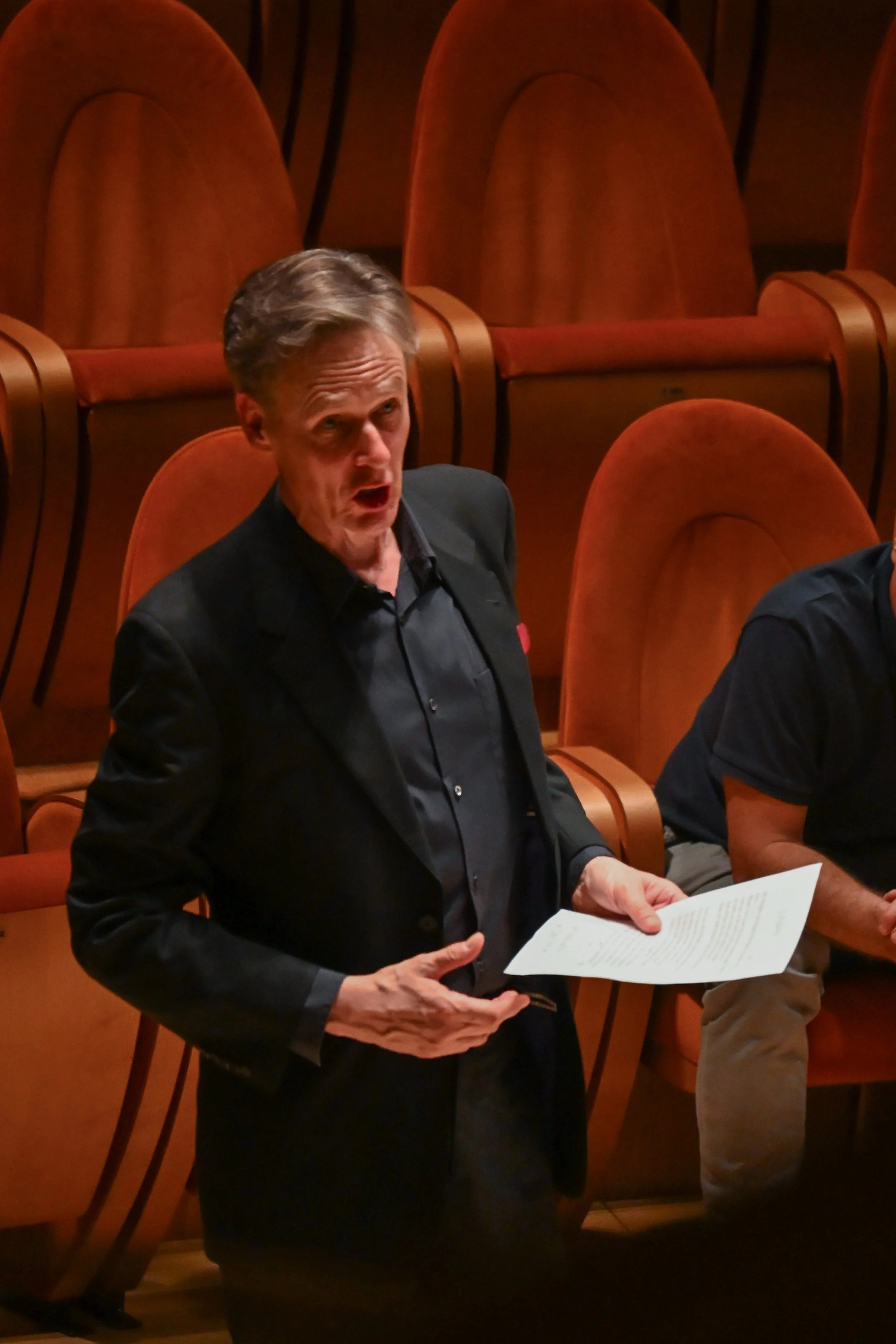
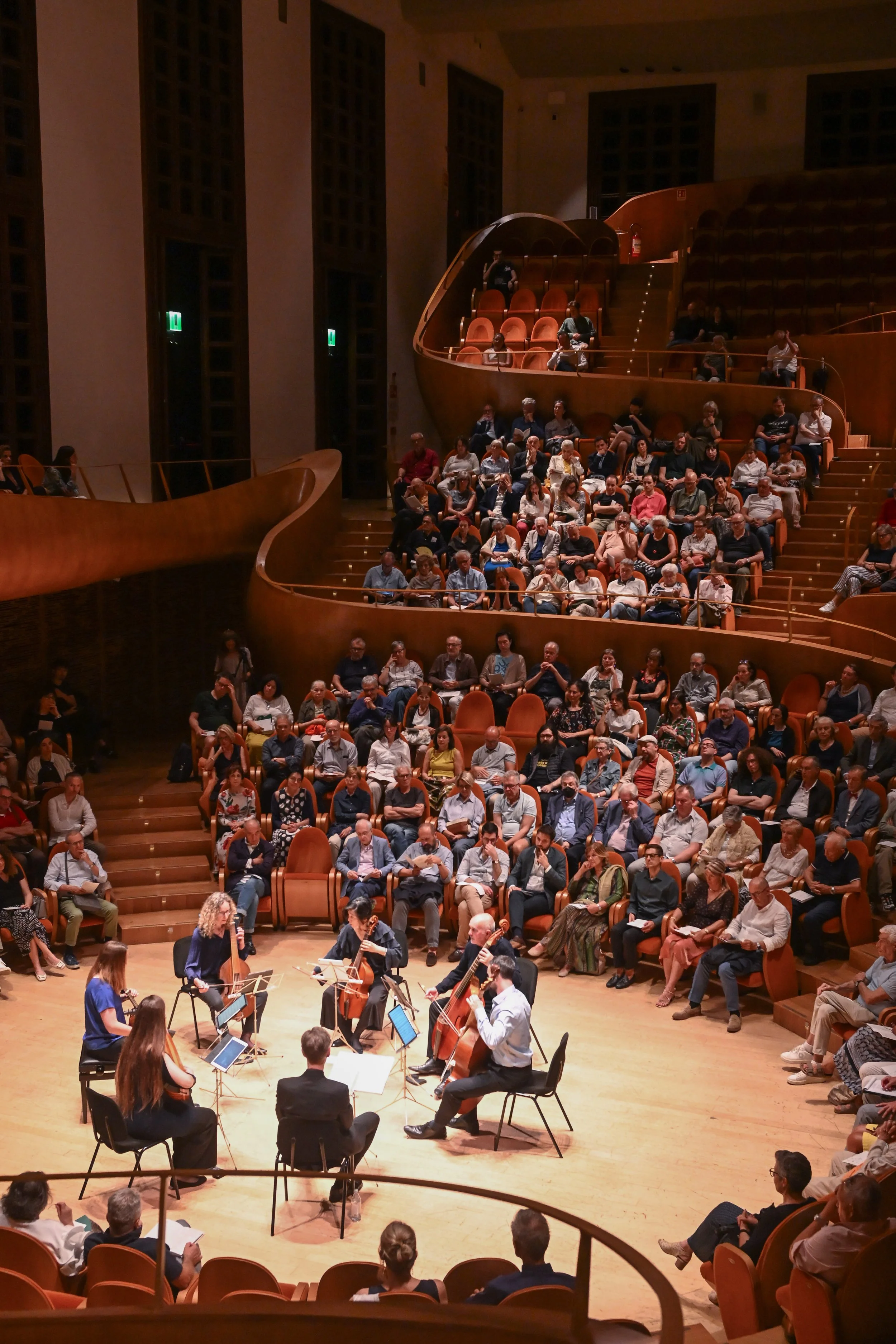
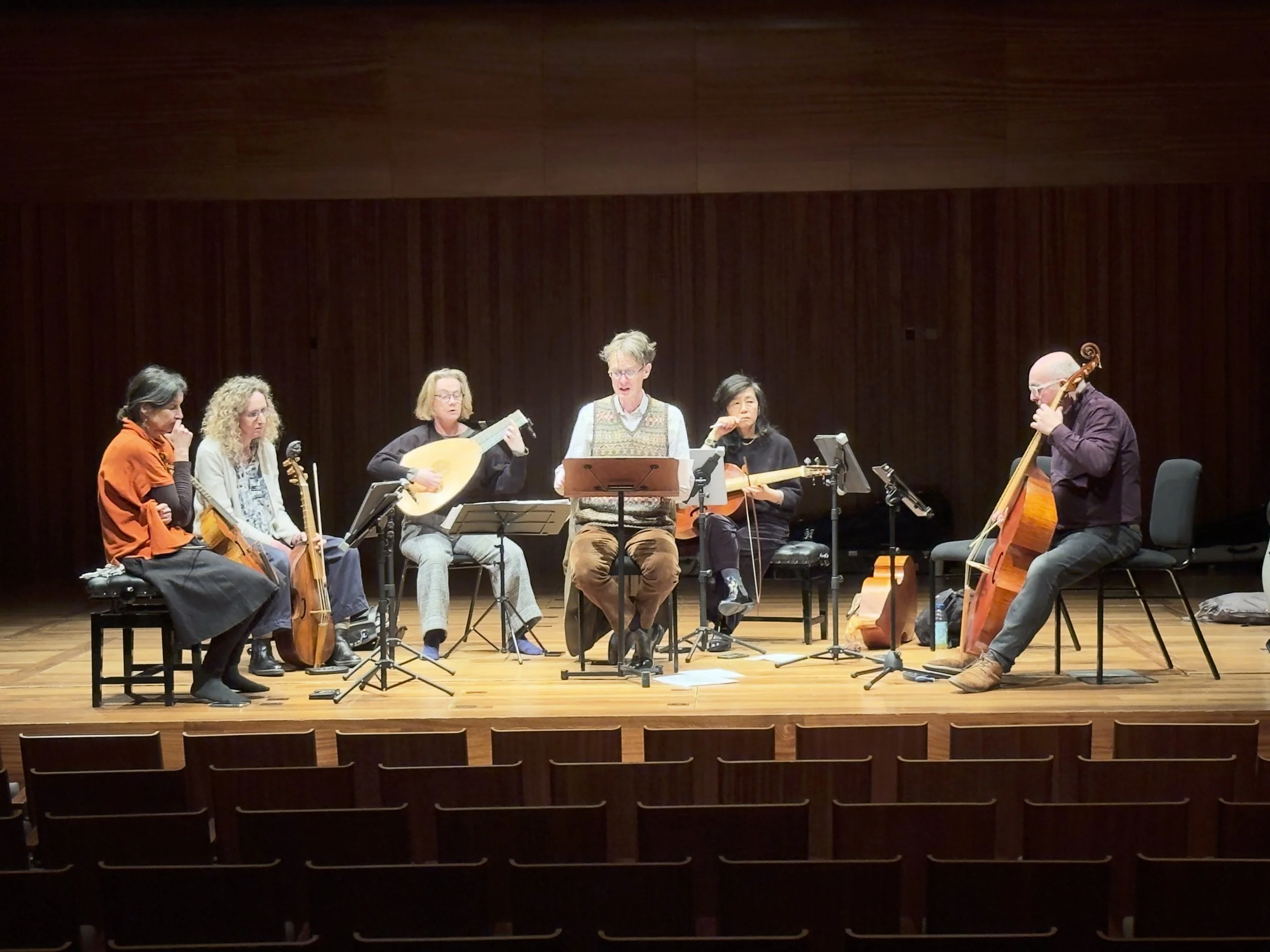
We played a programme of Dowland in Cremona with Ian Bostridge and Kristiina Watt. Here’s one of the reviews (English version below):
Straordinario concerto di Ian Bostridge all'Auditorium Arvedi
Quattro secoli dopo la morte, John Dowland continua a parlarci con una voce sorprendentemente contemporanea. Non è soltanto il cantore della malinconia elisabettiana, come una vulgata ormai abusata vorrebbe; è piuttosto il primo grande anatomista musicale dell'interiorità moderna. Nei suoi Songs of Ayres, nelle sue pavane, il dolore si fa linguaggio, la perdita diventa forma, la lacrima principio costruttivo. Non c'è compiacimento elegiaco, ma una continua interrogazione dell'animo umano, una drammaturgia del dubbio e dell'assenza che attraversa i secoli senza perdere forza.
A quattrocento anni dalla morte, il Monteverdi Festival gli ha reso omaggio con un concerto monografico affidato a uno dei suoi interpreti più autorevoli: Ian Bostridge, accompagnato dalla liutista Kristiina Watt e dal consort di viole Fretwork. Nello scrigno dell’Auditorium Arvedi, lo scorso 11 giugno, il programma si addentrava nel cuore stesso dell'universo dowlandiano, alternando pagine celebri come Flow my tears, Come again, I saw my lady weep e In darkness let me dwell alle meditazioni strumentali delle Lachrimae, vero monumento della melanconia. Bostridge non cerca di restituire una presunta autenticità storica. Cerca qualcosa di più difficile: l'attualità emotiva di questa musica. Lo fa attraverso una lettura ormai radicalmente interiorizzata. La voce non possiede più l'abbagliante freschezza di un tempo. Il timbro si è assottigliato, il colore si è fatto più opaco, l'emissione denuncia talvolta il peso degli anni. Eppure, proprio questa fragilità sembra oggi diventare parte integrante del discorso espressivo. Di quella vocalità è rimasta la nobile armatura: una filigrana sonora che rinuncia a ogni seduzione esteriore per concentrarsi sulla parola. Bostridge canta come chi medita. Ogni frase è modellata con un'intelligenza narrativa rarissima; ogni inflessione sembra nascere dall'urgenza del testo. Laddove molti interpreti cercano la bellezza del suono, lui persegue la verità dell'accento. È una forma di teatro mentale, costruita per minime variazioni, per esitazioni, sospensioni, improvvisi addensamenti emotivi. Così, In darkness let me dwell diventava qualcosa di più di una semplice canzone: un manifesto poetico. Non soltanto di Dowland, ma dello stesso Bostridge. In quelle ombre, in quella continua oscillazione tra abbandono e resistenza, la sofferenza non veniva esibita ma, piuttosto, osservata, quasi studiata, fino a trasformarsi, attraverso quel commovente, lucido scandaglio, in esperienza universale.
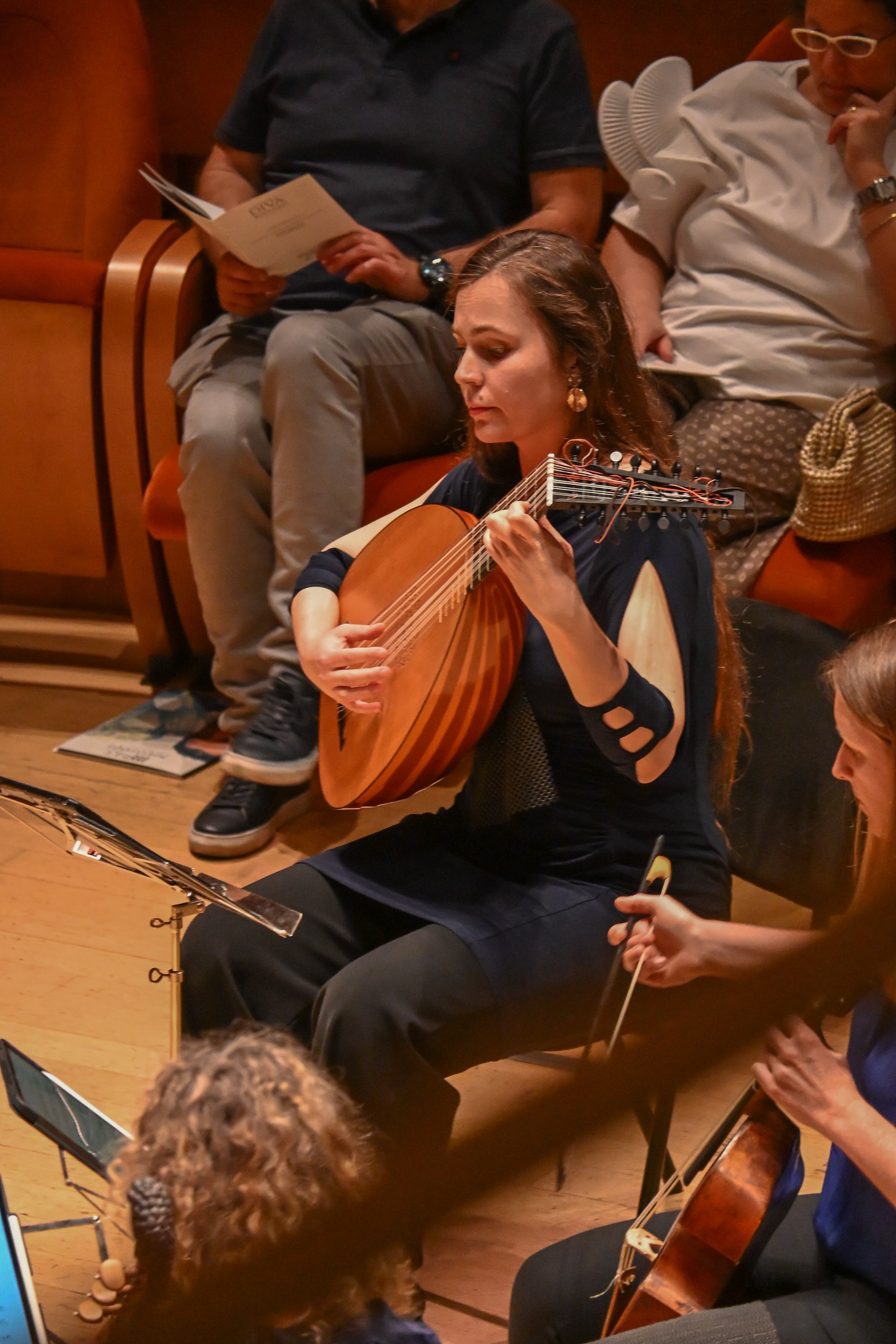
Accanto a lui, il liuto di Kristiina Watt tesseva una trama sottile, insinuante, di straordinaria duttilità. Era suo il filo invisibile che teneva insieme il racconto, la voce segreta chiamata ad assecondare e commentare, con ogni arpeggio che sembrava nascere dal silenzio per presto ritornarvi. Una presenza discreta ma decisiva, custode raffinata dell'eredità della grande scuola liutistica britannica. Ancora più impressionante il contributo di Fretwork, ensemble che da decenni rappresenta un punto di riferimento assoluto nell'interpretazione del repertorio per viole da gamba. Le Lachrimae emergevano come un capolavoro di architettura affettiva: non semplici variazioni sul celebre tema di Flow my tears, ma un itinerario spirituale in cui il motivo del pianto si trasformava continuamente, assumendo sfumature di mestizia, rassegnazione, nostalgia, desiderio e persino speranza. Il suono del consort, omogeneo e luminoso pur nella sua severità, restituiva tutta la modernità di una scrittura che sembra anticipare la psicologia musicale dei secoli successivi. Al termine di un ascolto densissimo, l'impressione era che Dowland appartenga forse più al nostro tempo che al suo. Il suo dolore è una malinconia riflessiva, consapevole, letteraria. Un sentimento che raccoglie il segreto tormento petrarchesco e prefigura lo spleen di Baudelaire e certe inquietudini della modernità. Le sue lacrime diventano materia d'arte; i suoi ripiegamenti interiori, mappe dell'esperienza umana. e quando la musica si animava in ritmi di danza, non era mai il corpo a prevalere: anche le gagliarde e le almande si trasfiguravano a danze della mente, percorse da una sottile inquietudine. Un teatro in cui si danza restando immobili, come accade nei sogni.
A suggellare la serata, l'omaggio a Benjamin Britten, altro grande artista profondamente legato all'eredità di Dowland. Una presenza quasi inevitabile: pochi compositori del Novecento hanno saputo comprendere così intimamente il maestro elisabettiano, trasformandone la malinconia in linguaggio contemporaneo. Due mondi lontani quattro secoli che finivano per coincidere, suggellando con questo prezioso lascito il concerto, a dimostrazione che alcune domande restano aperte per sempre.
Ian Bostridge's extraordinary concert at the Arvedi Auditorium
Four centuries after his death, John Dowland continues to speak to us with a surprisingly contemporary voice. He is not merely the bard of Elizabethan melancholy, as an overused cliché would have it; he is rather the first great musical anatomist of modern interiority. In his Songs of Ayres, in his pavanes, pain becomes language, loss becomes form, tears become a constructive principle. There is no elegiac complacency, but a constant interrogation of the human soul, a dramaturgy of doubt and absence that spans the centuries without losing its force.
Four hundred years after his death, the Monteverdi Festival paid tribute to him with a monographic concert entrusted to one of his most authoritative interpreters: Ian Bostridge, accompanied by lutenist Kristiina Watt and the Fretwork viola consort. In the treasure trove of the Arvedi Auditorium, last June 11th, the program delved into the very heart of Dowland's universe, alternating famous pieces like "Flow My Tears," "Come Again," "I Saw My Lady Weep," and "In Darkness Let Me Dwell" with the instrumental meditations of Lachrimae, a true monument to melancholy. Bostridge doesn't seek to restore a presumed historical authenticity. He seeks something more difficult: the emotional relevance of this music. He does so through a reading that is now radically internalized. The voice no longer possesses the dazzling freshness of the past. The timbre has thinned, the color has become duller, the emission at times betrays the weight of age. Yet, precisely this fragility seems today to become an integral part of the expressive discourse. Of that vocality, the noble armor remains: a sonic filigree that renounces all external seduction to focus on the word. Bostridge sings like one meditating. Each phrase is crafted with a rare narrative intelligence; Every inflection seems to arise from the urgency of the text. Where many performers seek the beauty of sound, he pursues the truth of accent. It's a form of mental theater, constructed through minimal variations, hesitations, suspensions, sudden emotional concentrations. Thus, "In Darkness Let Me Dwell" became something more than a simple song: a poetic manifesto. Not just for Dowland, but for Bostridge himself. In those shadows, in that constant oscillation between abandonment and resistance, suffering was not exhibited but, rather, observed, almost studied, until it was transformed, through that moving, lucid probing, into a universal experience.
Next to him, Kristiina Watt's lute wove a subtle, insinuating plot of extraordinary flexibility. Hers was the invisible thread that held the story together, the secret voice called upon to second and comment, with each arpeggio seeming to arise from silence only to quickly return to it. A discreet yet decisive presence, a refined guardian of the legacy of the great British lute school. Even more impressive was the contribution of Fretwork, an ensemble that for decades has been an absolute benchmark in the interpretation of the viol repertoire. The Lachrimae emerged as a masterpiece of affective architecture: not simple variations on the famous theme of "Flow My Tears," but a spiritual journey in which the weeping motif continually transformed, taking on nuances of sadness, resignation, nostalgia, desire, and even hope. The consort's sound, homogeneous and luminous despite its severity, conveyed all the modernity of a writing that seems to anticipate the musical psychology of subsequent centuries. At the end of a very intensive listening session, the impression was that Dowland perhaps belongs more to our time than his own. His pain is a reflective, conscious, literary melancholy. A feeling that captures Petrarch's secret torment and prefigures Baudelaire's spleen and certain anxieties of modernity. His tears become the material of art; His inner reflections, maps of human experience. And when the music came alive with dance rhythms, the body never prevailed: even the galliards and almandes were transfigured into dances of the mind, pervaded by a subtle restlessness. A theater where one dances while remaining still, as happens in dreams.
The evening concluded with a tribute to Benjamin Britten, another great artist deeply connected to Dowland's legacy. His presence was almost inevitable: few twentieth-century composers have been able to understand the Elizabethan master so intimately, transforming his melancholy into contemporary language. Two worlds, four centuries apart, ended up coinciding, sealing the concert with this precious legacy, demonstrating that some questions remain forever unanswered.
The Resurrection History review - touching and wonderfully understated.
★★★★☆ The Times, 6th April 2026 - Richard Morrison
‘The crystal-clear singing was beautifully matched by the viol consort Fretwork in this Wigmore Hall performance of Heinrich Schütz’s gentle 1623 setting of the Easter gospel.
The Resurrection History Wigmore Hall, London With so much Easter message point-scoring happening on the semi-lunatic fringes of our political life I expected the Wigmore Hall to be packed for this touching performance of Heinrich Schütz’s The Resurrection History. Alas, I didn’t spot a single shouty luminary from the far right, far left or anywhere in between. Pity. There’s a gentleness and quiet integrity about Schütz’s setting of the Easter gospel, composed in Dresden in 1623. It reminds us that faith should be an intensely personal matter, not a propaganda tool.
For a start, there’s not a whiff of triumphalism about the piece. Schütz wrote his 50-minute setting for small-scale forces, though perhaps not quite as small-scale as in this performance directed by Richard Boothby. The indefatigable Charles Daniels sometimes needed to have dialogues with himself, as both the Evangelist and a succession of minor characters. That said, the singing — particularly by the tenor Simon Wall as Christus — was crystal-clear and free of affectation, and beautifully complemented by the viol consort Fretwork.
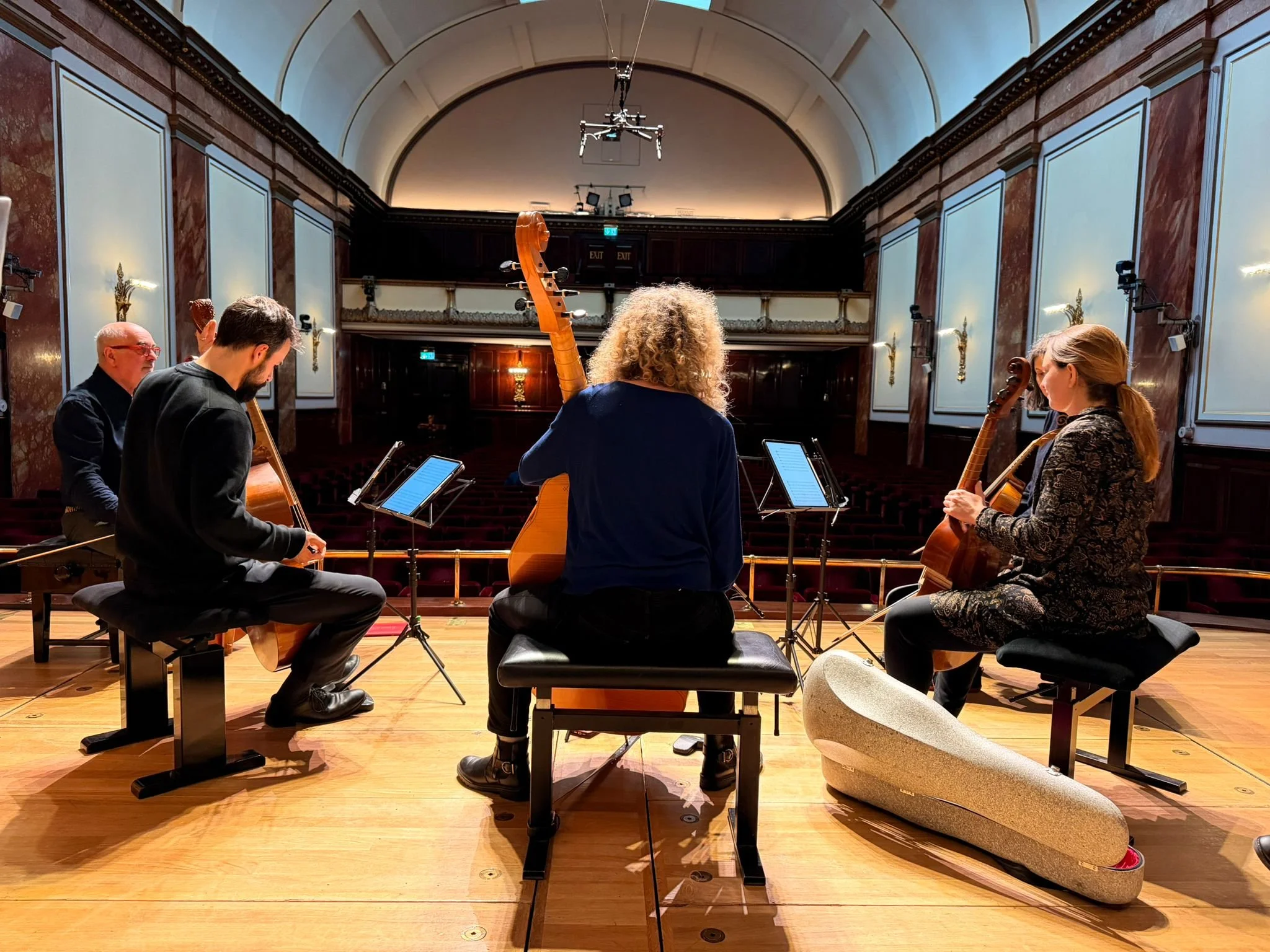
Those viols are vital to Schütz’s mellow conception. They accompany the Evangelist’s recitatives, first with a held chord — allowing him absolute freedom to point the words and control the rhythms — but then with a cadential flourish to end each of his sentences. In this performance, however, the top viol often improvised elegantly over the held chord, adding an extra dimension of musical interest. And the bass viol also had an important part, duetting with Christus over otherworldly harmonies.
Mary Magdalene was, strangely, also portrayed as a dual-voice: by two sopranos in counterpoint. Why? Was Schütz making some subtle theological point (too subtle for me, if so), or was it simply an early instance of every choirmaster’s nightmare: two competing sopranos who both wanted to sing the part? Either way, the whole piece is a wonderfully understated telling of this strange, supernatural story, in which the disbelief of the disciples looms larger than the certainty of the final, rejoicing chorus. Like so much of Schütz it deserves to be far better known. ‘
Dowland at Milton Court
★★★☆☆ The Times, 4th March 2026
An evening of arguably the most melancholic music ever written would not be everyone’s idea of a milestone-birthday knees-up, but then Fretwork isn’t just anyone. Celebrating its 40th year without fanfare or ceremony, the viol consort captivated with its programme of (almost) all Dowland, the Renaissance lutenist-composer whose personal motto was “semper Dowland, semper dolens” (always Dowland, always doleful).Paradoxically, it was hard not to feel enlivened by Fretwork’s exquisite playing, showcased in a programme that weaved songs and instrumental music into a flowing sequence, interrupted only by short tuning breaks. Some composers from centuries past sound as if they have been written yesterday. Not Dowland, at least not in this intimate performance at Milton Court. Here we were transported in note and word to an Elizabethan era of flickering candlelight and shifting shadows, to the age of Shakespeare and Burton’s The Anatomy of Melancholy.
Dowland dissects and delves into melancholy in his magnificent 1604 Lachrimae, or “Seven Teares”, and these slow instrumental pavanes provided the concert’s thread. Each opens with a falling motif evoking tears, anchoring the ear each time the theme returns. With beautiful blend, immaculate intonation and deft manoeuvring through closely woven lines, Fretwork found the light and shade in these pearl-like pieces, reminding us of Dowland’s promise that “neither are teares shed always in sorrow, but sometimes in joy and gladnesse”.
And it is true Dowland did not only wallow in gloom. He could pen a lively dance, as a handful of Galliards proved, and put musicians through their technical paces. For Forlorn Hope Fancy, the musicians tapered down to just solo lute, the wondrous Elizabeth Kenny, who led us through the demanding chromatic labyrinth in spellbinding fashion. Adrian Williams’s Teares to Dreams added a pleasant if superfluous contemporary response to Dowland.
Still, at times, especially in the more vigorous numbers, Bostridge’s voice came into eloquent focus, revealing to us once again the genius of Dowland, 400 years after his death.
À la Salle Gaveau, Ian Bostridge retrouve l’univers mélancolique de John Dowland aux côtés de la luthiste Elizabeth Kenny et du consort de violes Fretwork. Un programme sobre centré sur les Lachrimae et plusieurs songs du compositeur anglais.
Olyrix 18th March 2026: Rafael Mogollón
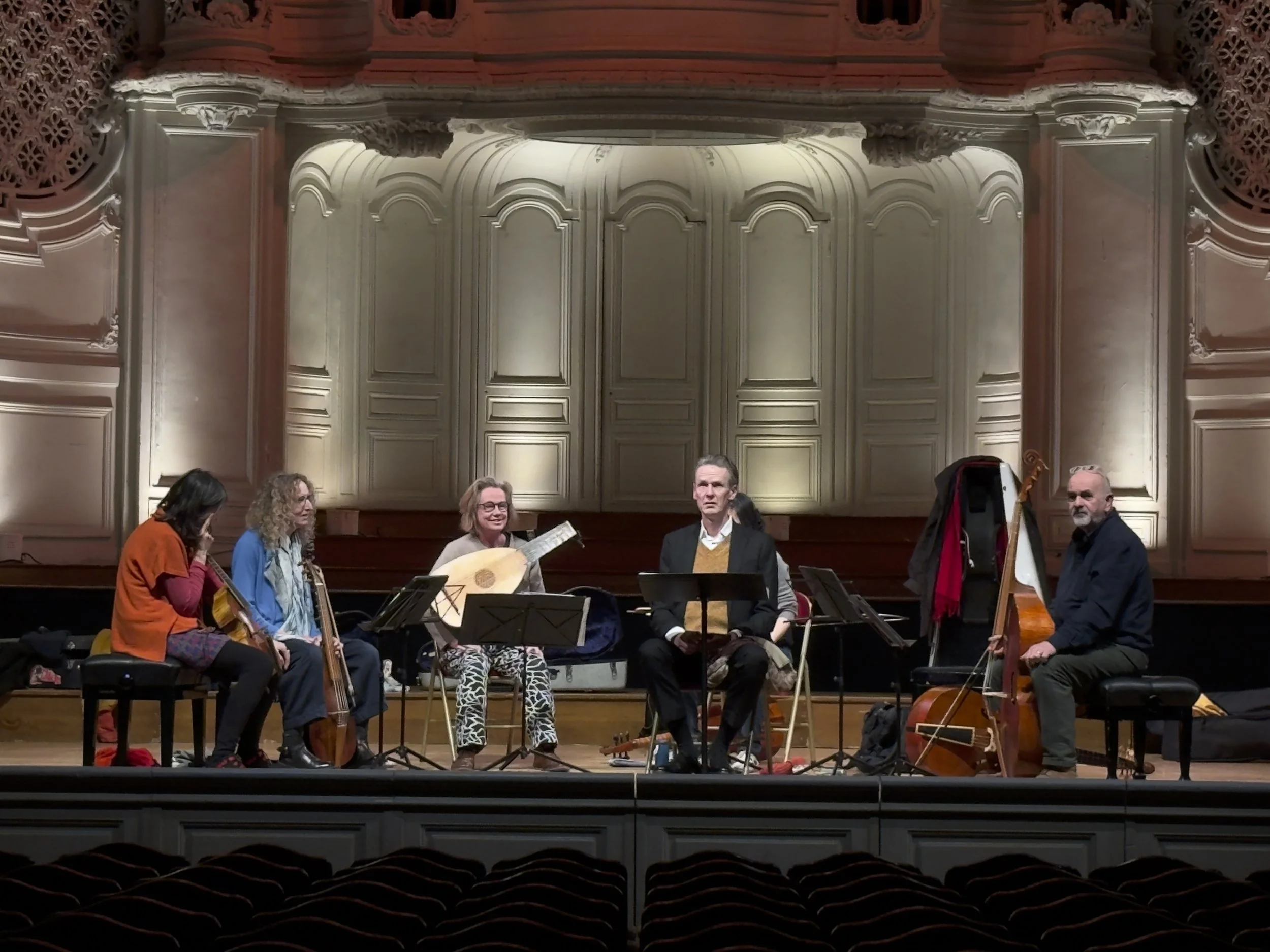
‘Réunis autour du ténor Ian Bostridge, la luthiste Elizabeth Kenny et les musiciens du consort de violes Fretwork proposent un programme consacré au compositeur anglais, alternant les célèbres Lachrimae et plusieurs de ses songs. Le concert se déploie en deux parties d’environ quarante minutes chacune, encadrant un entracte. Aucune mise en scène ni dispositif particulier : le chanteur au centre, entouré en demi-cercle par les violes et le luth. Cette disposition simple instaure d’emblée une atmosphère de concentration musicale, presque chambriste, où chaque nuance semble pouvoir circuler librement entre les interprètes.
La construction du programme alterne différentes configurations instrumentales. Certaines pages mettent en avant le consort de violes, d’autres associent la voix à l’ensemble ou au seul luth, tandis qu’une pièce instrumentale pour luth seul permet d’entendre l’instrument dans toute la richesse de son timbre. Ce jeu de contrastes révèle la richesse expressive de l’univers de Dowland, dont la musique explore inlassablement les multiples visages de la mélancolie. Les textes chantés évoquent l’amour contrarié, la solitude ou la plainte, mais toujours avec une élégance poétique qui transforme la douleur en matière musicale d’une grande délicatesse.
Dans ce répertoire, Ian Bostridge s’impose comme un conteur d’exception. Le ténor choisit de chanter presque tout le concert assis, choix qui accentue l’impression d’intimité et de proximité avec le public. Loin de toute recherche d’effet spectaculaire, son interprétation se distingue par une sincérité expressive remarquable. Chaque mot semble pesé, chaque inflexion du texte trouve son prolongement naturel dans la ligne musicale.
La diction précise et la prosodie attentive rendent particulièrement intelligible la poésie des songs, tandis que le chanteur déploie une palette de nuances très large : pianos suspendus, presque murmurés, puis soudains élans passionnés qui font surgir la tension dramatique des textes. Surtout, Bostridge semble adresser chaque pièce directement au public, promenant son regard dans la salle comme s’il racontait chaque histoire à une personne précise.
Autour de lui, Elizabeth Kenny et les musiciens de l'ensemble Fretwork font preuve d’une admirable cohésion. Leur interprétation se caractérise avant tout par une grande humilité musicale : malgré l’évidence de leur virtuosité, aucun ne cherche à s’imposer individuellement. La musique demeure constamment au premier plan.
Le jeu du consort de violes se distingue par une sonorité chaleureuse et homogène, d’une grande souplesse dans les lignes contrapuntiques. Le luth d’Elizabeth Kenny, à la fois discret et essentiel, assure la continuité du discours musical avec une élégance et une clarté remarquables. Ensemble, les musiciens donnent l’impression de partager un même souffle, révélant la subtilité de cette musique qui se nourrit autant de silence que de son.
Le public, particulièrement attentif tout au long du concert, réserve aux artistes des applaudissements chaleureux. En guise de bis, les interprètes offrent d’abord un moment d’une douceur mélancolique avec Down by the Salley Gardens, unique pièce du programme qui n’est pas de Dowland, chantée cette fois debout par Bostridge. Puis, la soirée se conclut par la reprise de Can she excuse my wrongs, comme un clin d’œil final à la poésie élégiaque du compositeur.
Sans effets superflus ni démonstration ostentatoire, cette soirée à la Salle Gaveau donne surtout l’impression d’une véritable leçon de musicalité et de goût : une interprétation sincère et profondément habitée, où l’intelligence du texte et la beauté du son se rejoignent pour servir l’art subtil de John Dowland.’
_________________________________________
‘At the Salle Gaveau, Ian Bostridge revisits the melancholic world of John Dowland alongside lutenist Elizabeth Kenny and the Fretwork viol consort. A restrained program centered on the Lachrimae and several songs by the English composer.
Gathered around tenor Ian Bostridge, lutenist Elizabeth Kenny and the musicians of the Fretwork viol consort present a program dedicated to the English composer, alternating between the famous Lachrimae and several of his songs. The concert unfolds in two parts of approximately forty minutes each, framing an intermission. There is no staging or special arrangement: the singer at the center, surrounded in a semicircle by the viols and the lute. This simple layout immediately establishes an atmosphere of musical concentration, almost chamber music-like, where every nuance seems to flow freely among the performers.
The program's structure alternates between different instrumental configurations. Some pieces showcase the viol consort, others combine voice with the ensemble or with the lute alone, while an instrumental piece for solo lute allows the instrument to be heard in all the richness of its timbre. This interplay of contrasts reveals the expressive richness of Dowland's world, whose music tirelessly explores the many facets of melancholy. The sung texts evoke thwarted love, loneliness, or lament, but always with a poetic elegance that transforms pain into exquisitely delicate musical material.
In this repertoire, Ian Bostridge establishes himself as an exceptional storyteller. The tenor chooses to sing almost the entire concert seated, a choice that accentuates the feeling of intimacy and closeness with the audience. Far from any pursuit of spectacular effect, his interpretation is distinguished by a remarkable expressive sincerity. Every word seems carefully chosen, every inflection of the text finds its natural extension in the musical line.
Precise diction and attentiveprosody make the poetry of the songs particularly intelligible, while the singer displays a wide range of nuances: suspended, almost whispered pianos, then sudden bursts of passion that bring out the dramatic tension of the texts. Above all, Bostridge seems to address each piece directly to the audience, his gaze sweeping the hall as if he were telling each story to a specific person.
Around him, Elizabeth Kenny and the musicians of the Fretwork ensemble demonstrate admirable cohesion. Their performance is characterized above all by great musical humility: despite their evident virtuosity, none of them seeks to impose themselves individually. The music remains constantly at the forefront. The playing of the viol consort is distinguished by a warm and homogeneous sound, with great flexibility in the contrapuntal lines. Elizabeth Kenny's lute, both discreet and essential, ensures the continuity of the musical discourse with remarkable elegance and clarity. Together, the musicians seem to share a single breath, revealing the subtlety of this music, which thrives as much on silence as on sound.
The audience, particularly attentive throughout the concert, rewarded the artists with warm applause. As an encore, the performers first offered a moment of melancholic sweetness with "Down by the Salley Gardens," the only piece on the program not by Dowland, sung this time standing by Bostridge. Then, the evening concluded with a reprise of "Can she excuse my wrongs," a final nod to the composer's elegiac poetry. Without superfluous effects or ostentatious displays, this evening at the Salle Gaveau gave above all the impression of a true lesson in musicality and taste: a sincere and deeply felt interpretation, where the intelligence of the text and the beauty of the sound converge to serve the subtle art of John Dowland.’